
A new video game called Façade has just been released to the public. I'll say this right up front: Façade is one of the most important games ever created, possibly the most important game of the last ten years. More important than The Sims; more important than Grand Theft Auto; far more important than Half-Life. If you are a game designer, or you want to be a game designer, you must play this game. It runs on the PC, and it's free. It was developed by Michael Mateas, an AI professor at Georgia Tech, and Andrew Stern, the man behind the Dogz, Catz, and Petz series from p.f. Magic a few years ago. You can download it at www.interactivestory.net. You'll need a Bittorrent client and some patience; it's 800MB.
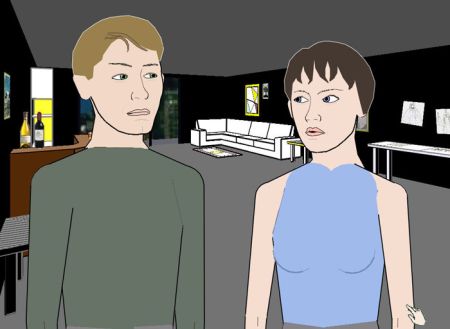
Trouble's stirring...
Mateas wrote his Ph.D. thesis on Façade, and he and Stern have written several other articles as well, so there is quite a lot of published material about it already. I have deliberately avoided reading any of it, however, because I wanted to experience Façade as a gamer, not as a game developer. I don't know for sure what they were trying to do; I only know what they did do and how I feel about it, which is deeply impressed. Façade isn't a game in the formal sense of the word. It's a one-act interactive drama. That genre doesn't get much attention these days—we're more concerned with storytelling in general—but interactive drama is vital to the future of the medium, and Façade is a big step forward in that field.
One of the things that makes theater different from movies is the physically limited size of the stage. Another is that theater is live and immediate. On a stage you can't show an earthquake destroying all of Los Angeles, but you can show people who are affected by that earthquake, and what it means for them personally. In theater it is the actors who carry the story, and the story is conveyed to the audience primarily through dialog. That's unusual for videogames. Games rely on action to carry the story, and the plot is most often about big impersonal issues like saving the world. Façade is a drama, so it takes place on a stage: a small and rather spartan apartment. Its central issue is not saving the world, but saving a marriage.
As the player in Facade, you are an old friend of a married couple whom you haven't seen for a while. Their names are Trip and Grace, and you've been invited over to their place for a drink one evening. You see them in the first person, and you can move around with the arrow keys and talk to them by typing on the keyboard. They speak back to you, and to each other, in recorded audio. (I should add for the benefit of younger readers that Façade would probably get an R rating for language, and it hasn't been rated by the ESRB.) You can also use the mouse cursor to pat them comfortingly, hug them, and kiss them. That's about it. But that's all you need.
Like the early adventure games, Façade doesn't make any assumptions about your character, or assign you any role other than that of an old friend. At the beginning of the story you choose your name, and that implies what sex you are, but you have no personality except what you bring with you. This leaves you free to act any way you like. You're not playing a part written for you by someone else.
It quickly becomes apparent, even before you get in the door, that Trip and Grace's relationship is in trouble. It's a façade, as the name suggests. They're young, they're affluent, and they're deeply unhappy with each other. They're hoping that by talking to you, they might arrive at some kind of understanding about what's wrong between them. Your conversation has a direct effect on their feelings about each other, and about you as well. There are several possible outcomes, and I doubt if I've seen them all. In one, they make up and resolve to try again; in another, one of them walks out; in yet another, I made Trip so mad he kicked me out of the apartment.
Façade doesn't give you a goal, which is why it's not a game. You can try to save their marriage, or you can try to split them up, or anything else you feel like. There's no way to win or lose, no value judgments about the quality of your play. By avoiding the "game" paradigm Façade also avoids a lot of baggage that games bring with them: connotations of strategy and competition, and the sense that it doesn't really matter. But although Façade isn't a game, it's also not a sandbox like The Sims, where the people speak in Simlish and it's fun to find new ways to kill them. (The Sims' website suggests that if you're low on money, you can murder a few sims in order to sell off their tombstones. That hardly encourages the player to empathize with his characters.) The characters in Façade speak of real pain in real words. You play not for the sake of a final score, but for the sake of something more important: Trip and Grace's happiness. By the end of the evening, something that you say or do may have changed their lives radically. That, too, is a new thing for videogames. Videogames have hitherto mostly been about changing things, not changing people.
All that is revolutionary enough by itself, but Façade also impresses me because it's so technically ambitious. Mateas and Stern describe it as a demonstration project, a testbed for new AI ideas and technologies. It tries to accomplish about five incredibly difficult things at once , and perhaps even more that I haven't yet noticed. These are the things that I saw the game doing:
- Natural language parsing and conversational interaction. It has been a long time since typing English on a keyboard was the standard way of interacting with a computer game. Even when it was, what you typed were usually simple commands like GO NORTH
and TAKE FLASHLIGHT. Façade accepts English input and tries to interpret it as a meaningful part of an ordinary human conversation. This is a gigantic challenge.
Conversation systems are not new. The best-known early one was Eliza, created by Joseph Weizenbaum in 1966. Eliza was a very simple program that was intended to parody a non-directive psychotherapist. All it really did was parrot variants of your own sentences back at you or request further information, sometimes recognizing a few keywords. Another famous conversation system, SHRDLU, was developed by Terry Winograd at Stanford. It was capable of discussing a collection of blocks that could be manipulated by a robot arm. You could say things like, "Are there any blocks which are wider than the one you are holding," and it would reply, YES, THE GREEN CUBE. It also remembered past events and could correct the user if he was wrong about something.
SHRDLU could only discuss things in a very limited context: the blocks world. Eliza had no context at all, and no real intelligence apart from recognizing keywords hard-coded into it. Façade is significantly more complex than either; it has to hold a three-way conversation on a wide variety of possible topics that affect a marriage: work, friends, parents, children, money, love, sex, and even interior decorating. It's not perfect by any means; at times the conversation engine "loses the plot," so to speak—it fails to understand your input and produces a non sequitur. Nevertheless, it's an important step forward.
- Natural language generation. Video games often sound stilted because their dialog is written as whole sentences, or long soliloquies by one character. Façade doesn't make this
error. Trip and Grace's conversation is full of hesitations, sentence fragments and interruptions; it sounds like real people talking, not spoken exposition. Facade produces pre-recorded utterances based on an internal mechanism, but it's not assembling individual words to create new sentences from scratch. Rather, it's choosing a line of dialog that's most appropriate for the current situation. I did the same when I wrote the play-by-play
commentary in Madden NFL Football, but in football the situation is considerably more straightforward than a deteriorating marriage! Façade also manages to avoid repetition, a classic weakness of many games that instantly destroys immersion. In Façade a character never says the same thing twice in any one play-through of the drama.
One area where the audio design fell down somewhat is in the "name insertion" technique, where the name you chose for yourself is inserted into the dialog. Trip and Grace say your name far too often, and its inflection and volume often don't match the rest of the sentence in which it is used. But this is a minor quibble; it doesn't reflect on the game's real achievements.
- Emotional modeling. The Sims' emotional modeling is based on needs (food, sleep, and so
on) plus some attributes that govern a character's affinity for another character (neatness, outgoingness, and so on). Because The Sims has to handle any character the player can create, it naturally needs a general mechanism for emotional relations, which consequently produces somewhat general results. Façade, on the other hand, is about two people who already know each other. Their relations are influenced by English-language sentences that
they speak to each other, and by those spoken to them by a third party, you. Your physical actions, such as touching or walking away, also affect both Trip and Grace's emotions. I have no idea how sophisticated their emotional modeling really is, but I thought I was able to detect anger, depression, frustration, jealousy, shock, bitterness, relief, embarrassment, gratitude, pleasure, and perhaps a dawning self-awareness. Much of my
reading of these emotions comes from the actors' tones of voice, so I may be giving it too much credit. Still, it's reasonable to assume that the language generator chooses a recorded sentence whose tone matches the character's underlying emotional state. Also, unlike many games that simulate emotion, Trip and Grace's feelings have some inertia—they don't swing wildly from one emotion to another. If they become angry, they stay that way for a while.
- Facial expressions. Façade uses flat-shaded 3D graphics, so no matter at what angle you see Trip and Grace, they look like very simple comic-book characters. However, their eyes, eyebrows, and lips are outlined in sharp detail, so you can see them clearly even from across the room. They reflect the character's feelings with some precision.
Facial expression modeling is the subject of a lot of research nowadays. It's incredibly tricky to get right, and if you're not careful you can end up with the Polar Express problem: your characters look like creepy robotic versions of real people. Most of this research centers around lip-synching spoken words rather than expressing emotions, especially when the character isn't saying anything. Notice how often videogame characters' faces return to a bland, neutral state when they're not talking. Mateas and Stern wisely avoided the Polar Express problem by going for low detail and not worrying about lip-synch too much. Instead they concentrate on reflecting the characters' inner feelings through their faces, and those feelings are still clearly visible even when he or she isn't talking.
- Body language. Trip and Grace both stand up the whole time (as far as I have seen), and they tend to wander around as you talk to them. Their walking and gestural movements aren't very realistic, which I attribute to Façade being a small, self-funded project. What's interesting, though, is the way their body language reflects their moods. They'll turn away from each other when angry, and fold their arms when upset, a classic defensive posture. Both of them tilt their heads appropriately too: down when unhappy, up when happy, to one side when puzzled. You see this kind of thing done in pre-rendered video all the time, under the guidance of a skilled animator; but in Façade it's all being simulated in real time. I couldn't tell if there are individual differences between the two characters; they both seemed to use the same postures.
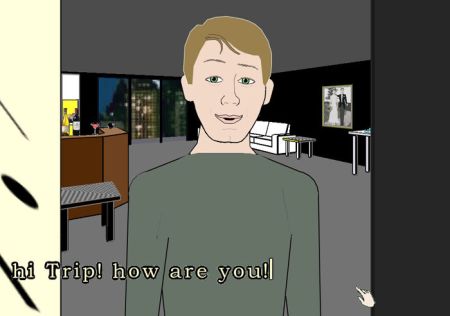
Trip greets you with a smile.
So is the plot of Façade embedded—pre-written—or is it emergent? Have I been taken in by nothing more than a vast branching storyline? Obviously some parts of it are scripted, literally, because all the conversation is recorded material. Trip and Grace can never say anything other than what Mateas and Stern have given them to say. But Façade is trying to interpret and react to whatever the player types, and the player can type anything at any time. You can't do that with a branching storyline. At the end of the day I think it doesn't really matter how Façade does what it does. It's entertainment. As a designer, of course I'm curious about what's behind the curtain, but as a player, all I want to do is believe in it.
At the beginning of this article I was careful to say that Façade was "important," but not that it was fun. Like theatrical drama, it goes beyond fun, in fun's traditional sense of "a good time." Nobody goes to see Who's Afraid of Virginia Woolf or Death of a Salesman for a good time. We see them to be entertained, to be moved, to appreciate a dramatic situation for its own sake. I don't really like either Trip or Grace, and whatever chemistry they once had has clearly evaporated, but I do sense their isolation and frustration, and it makes me want to help them.
Façade is not without its weaknesses, it is after all a demonstration project rather than a commercial product. The acting is not stellar, and the art and animation are pretty minimal. None of that matters, however. Façade is important for what it tries to do and for what it shows that we can do with this amazing medium of ours. It doesn't seek to replace anything; in the future there will still be plenty of games with the familiar themes of construction, exploration, and conquest. Rather, it shows us that there are still new ways to play waiting to be invented. The future of interactive entertainment will be even bigger and more manifold than it is now. Façade leads the way.